
Solar C-Pile — Lipped C-Channel Post
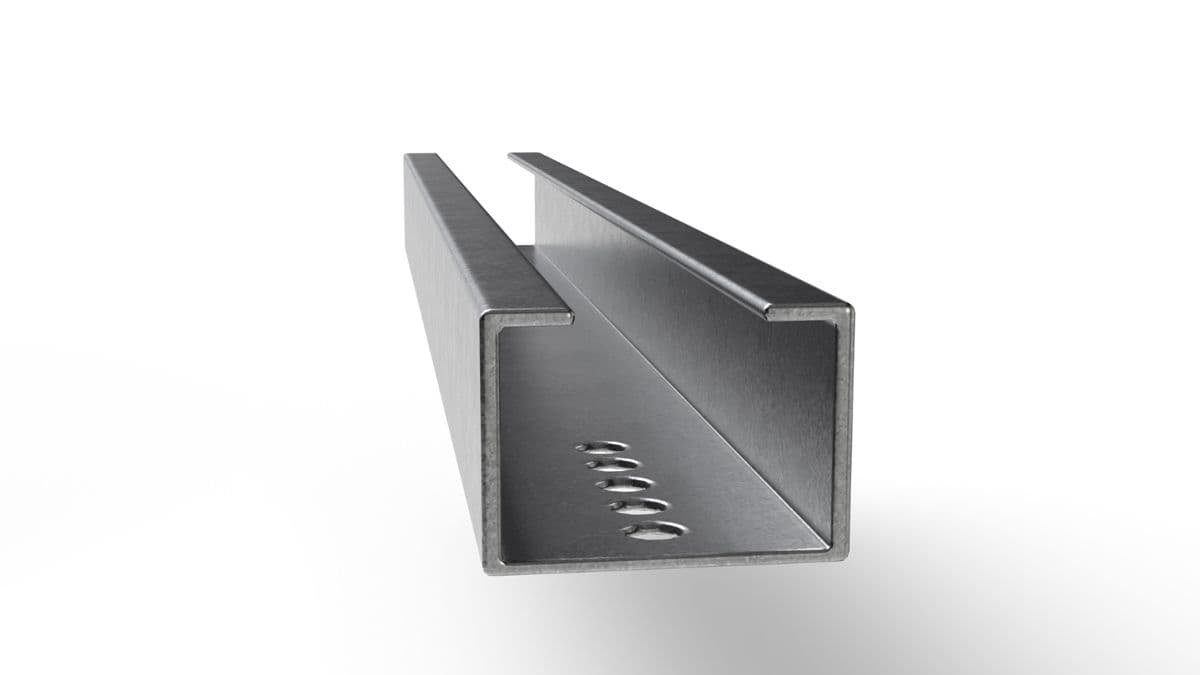
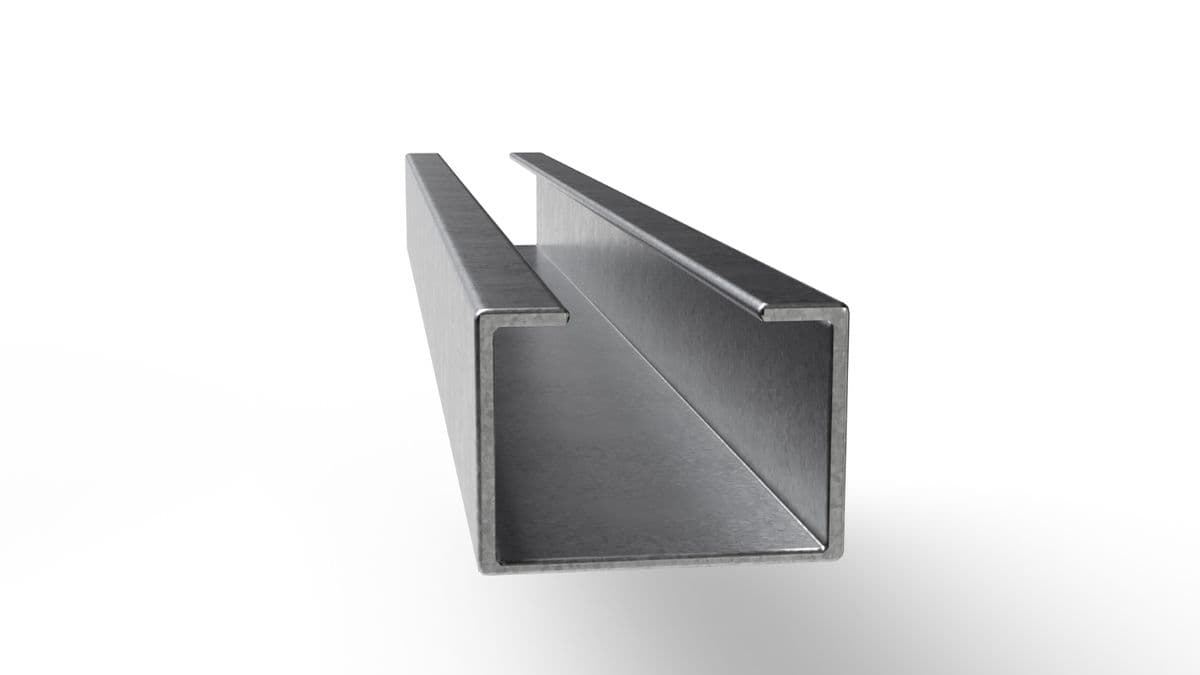
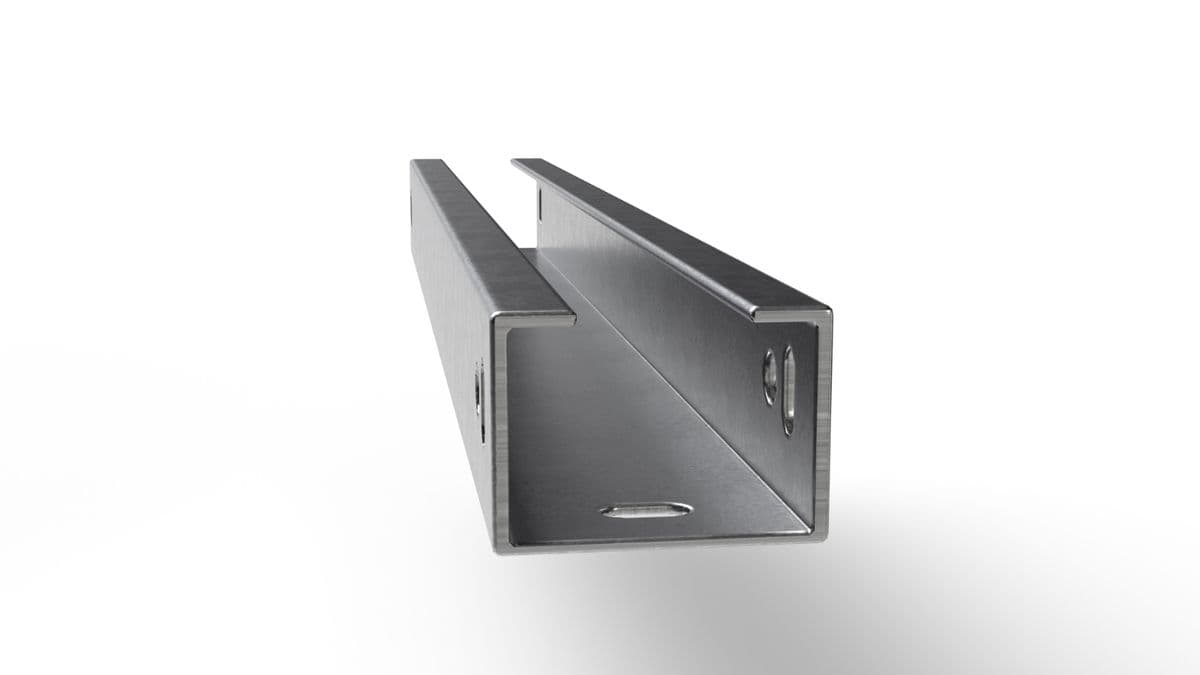
The most widely used foundation member in ground-mount solar: a cold-formed, lipped C-section post driven with a hydraulic rig. Rolled from pre-coated coil, punched in-line and cut to your length.
Specifications
- Section
- Lipped C, cold-formed
- Depth
- 100 – 240 mm
- Thickness
- 2.0 – 6.0 mm
- Material
- S350GD · S235JR (S250–S450GD)
- Coating
- Zn-Al-Mg ZM120–ZM430 · Galvanized Z275–Z600
- Holes
- Plain or punched in-line
- Length
- Cut to length
What a C-pile is and where it goes
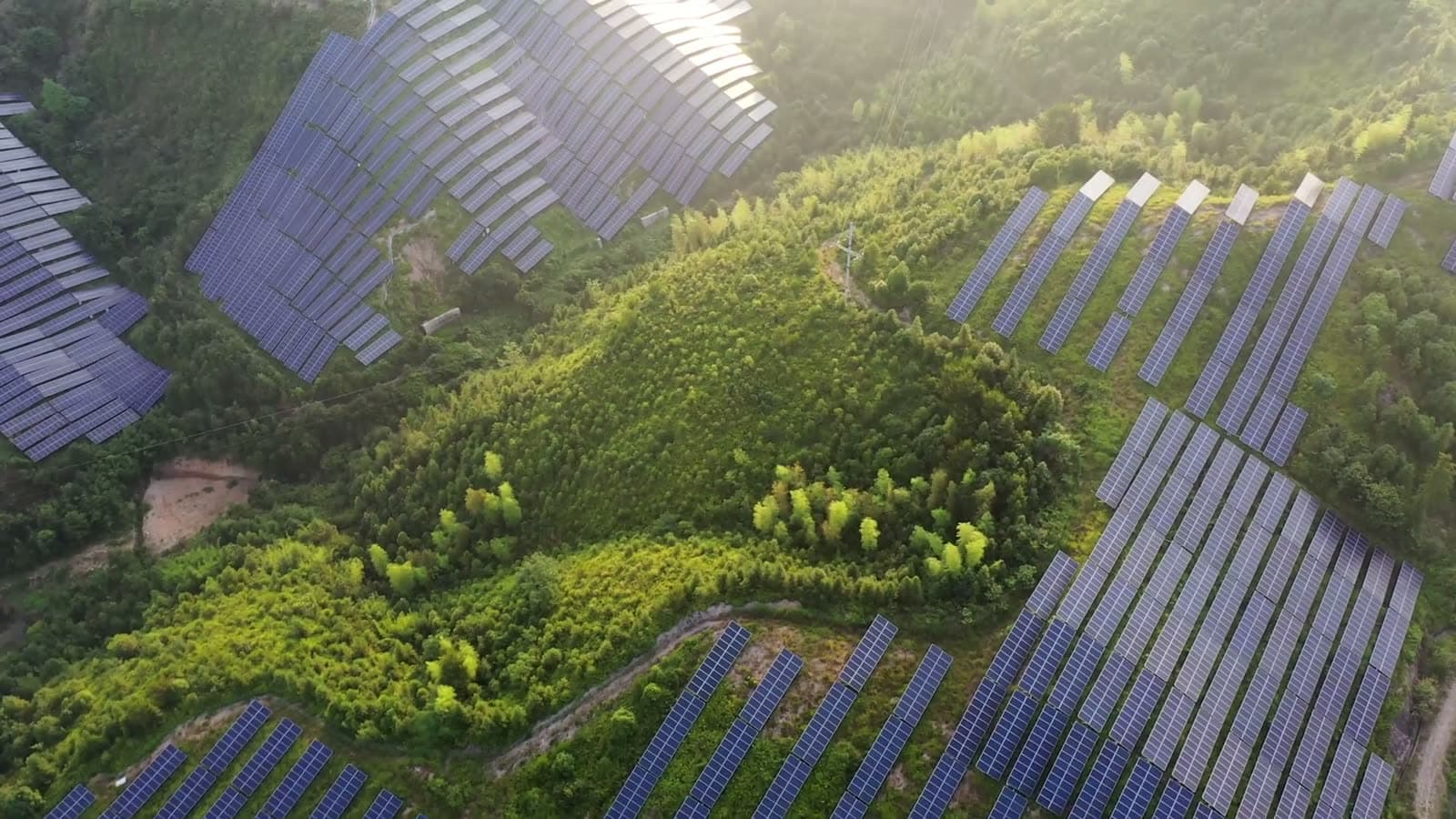
A C-pile is the post that carries the module tables of a ground-mount solar plant. It is driven with a hydraulic pile driver to the depth set by the geotechnical survey, and the rafter or chord that sets the module tilt is bolted to it through brackets. On most soils no concrete footing is needed, so installation is fast and field labour drops.
Depending on the table design a row can stand on single posts or on front and rear pairs. Pile spacing — together with the module layout (1V or 2V), wind and snow load — drives the section choice. The complete structure is described on our fixed-tilt solar mounting page.
Why a lipped C-section
The lips at the flange tips act as edge stiffeners: they delay local buckling of the thin-walled flanges under load. The result is higher load capacity and bending stiffness than an unlipped U-section of the same gauge — more structure per kilo of steel.
The open face lets brackets and fasteners bolt on at any height along the pile, which makes field tolerances easy to take up. Where more moment capacity is needed, a sigma pile is the step up; for lighter loads a U-pile is the economical option.
Choosing depth, gauge and grade
Web depth (h) sets the pile's bending capacity about its major axis, flange width (b) its minor-axis stiffness and the bracket seating face, the lip (c) the flange's resistance to buckling, and the thickness (t) both load capacity and resistance during driving. In hard or stony ground, gauge and — where needed — pre-drilling are assessed together so the thin-walled tip is not damaged.
Steel grade is a design lever too: S350GD is the standard choice; with high-yield S420GD or S450GD the same load is carried at a thinner gauge, lowering tonnage and cost. The final section comes from a structural calculation with the site's wind zone, snow load, soil class and seismic data — a calculation we also carry out to Eurocode 3 or ASCE 7.
Pre-punched or plain
Connection holes and adjustment slots are punched in the same pass as the profile is formed on the roll-forming line, so hole positions are identical across thousands of parts and there is no drilling, cutting or welding on site. Round holes, oval slots or custom patterns are punched to your drawing.
Plain C-piles suit projects connected with clamps or field-drilled holes, or jobs where the hole pattern is not yet fixed.
Coating: Zn-Al-Mg or galvanized
We form our C-piles from pre-coated coil: Zn-Al-Mg (ZM120–ZM430) or galvanized (Z275–Z600). Zn-Al-Mg self-heals at sheared and punched edges and lasts longer than galvanizing at the same coating mass. For a pile embedded in soil, the coating class is chosen from soil corrosivity, the atmospheric corrosion category and the plant's design life — see our Zn-Al-Mg vs galvanized guide.
Production, packing and shipping
Decoiling and levelling, roll forming, in-line punching and flying cut-off to length all happen on one line; profiles are bundled, strapped and labelled for site. With capacity above 2,500 tons a month we deliver utility-scale projects on plannable schedules — by truck across Türkiye, and by truck or container to Europe, the Middle East and North America.
What we need for a quote
For a fast, accurate price send: the section drawing (DXF/PDF) or h×b×c×t, steel grade, coating type and class, length and quantity list, hole pattern and delivery location. If you also want the structural calculation, the site location, module size and layout (1V/2V) are enough to start. You can upload files through our quote form.
Example C-pile sections — weights and section properties
| Section h×b×c×t (mm) | A (cm²) | Weight (kg/m) | Ix (cm⁴) | Wx (cm³) |
|---|---|---|---|---|
| C 100×50×15×2 | 4.34 | 3.40 | 69.2 | 13.85 |
| C 100×50×15×2.5 | 5.34 | 4.19 | 84.0 | 16.80 |
| C 100×50×15×3 | 6.31 | 4.95 | 97.8 | 19.55 |
| C 100×50×15×4 | 8.15 | 6.40 | 122.4 | 24.49 |
| C 120×50×20×2 | 4.94 | 3.88 | 109.4 | 18.24 |
| C 120×50×20×2.5 | 6.09 | 4.78 | 133.2 | 22.20 |
| C 120×50×20×3 | 7.21 | 5.66 | 155.6 | 25.94 |
| C 120×50×20×4 | 9.35 | 7.34 | 196.4 | 32.74 |
| C 150×60×20×2 | 5.94 | 4.66 | 207.2 | 27.63 |
| C 150×60×20×2.5 | 7.34 | 5.76 | 253.4 | 33.79 |
| C 150×60×20×3 | 8.71 | 6.84 | 297.5 | 39.67 |
| C 150×60×20×4 | 11.35 | 8.91 | 379.2 | 50.57 |
| C 180×70×20×2 | 6.94 | 5.45 | 349.4 | 38.83 |
| C 180×70×20×2.5 | 8.59 | 6.74 | 428.8 | 47.64 |
| C 180×70×20×3 | 10.21 | 8.01 | 505.0 | 56.11 |
| C 180×70×20×4 | 13.35 | 10.48 | 648.2 | 72.02 |
| C 200×70×20×2 | 7.34 | 5.76 | 446.8 | 44.68 |
| C 200×70×20×2.5 | 9.09 | 7.13 | 548.8 | 54.88 |
| C 200×70×20×3 | 10.81 | 8.48 | 647.0 | 64.70 |
| C 200×70×20×4 | 14.15 | 11.11 | 832.0 | 83.20 |
| C 240×60×15×2 | 7.54 | 5.92 | 608.8 | 50.73 |
| C 240×60×15×2.5 | 9.34 | 7.33 | 747.7 | 62.31 |
| C 240×60×15×3 | 11.11 | 8.72 | 881.3 | 73.44 |
| C 240×60×15×4 | 14.55 | 11.42 | 1,132.9 | 94.41 |
Theoretical values: 7.85 g/cm³, inner bend radius equal to thickness, coating excluded. Ix and Wx are gross-section values about the horizontal centroidal axis (centre-line method); effective properties to EN 1993-1-3 are lower depending on stress level. Sizes shown are examples — any size within the stated range can be rolled; the project's structural calculation sets the final section.
Frequently asked questions
How deep is a C-pile driven?
+
There is no single right depth: embedment is set by the geotechnical survey, the uplift from wind and pull-out tests on site. On many fixed-tilt sites it lands between 1.2 and 2.5 m, but soft ground needs more and rocky ground needs pre-drilling. Our pile driving and pull-out testing guide explains the method.
What is the difference between a C-pile and a sigma pile?
+
A sigma pile has a stepped, stiffened web, giving more bending capacity and local-buckling resistance at the same gauge. The C-pile is simpler and more common, and cheaper wherever loads and soil allow. High wind, large 2V tables or soft ground favour the sigma section.
How do you calculate the weight of a C-profile?
+
Weight per metre of a cold-formed C-profile = centre-line developed width (mm) × thickness (mm) × 7.85 ÷ 1000. Bend radii shorten the developed width slightly. For example a 150×60×20 mm, 2.5 mm C-profile weighs about 5.76 kg/m.
Can you roll our own section?
+
Yes. We design and make roll-forming tooling in-house, so sections specific to your platform go to first article and series production quickly. A drawing, the material and an estimated footage are enough — we reply with a manufacturability review.
Related profiles
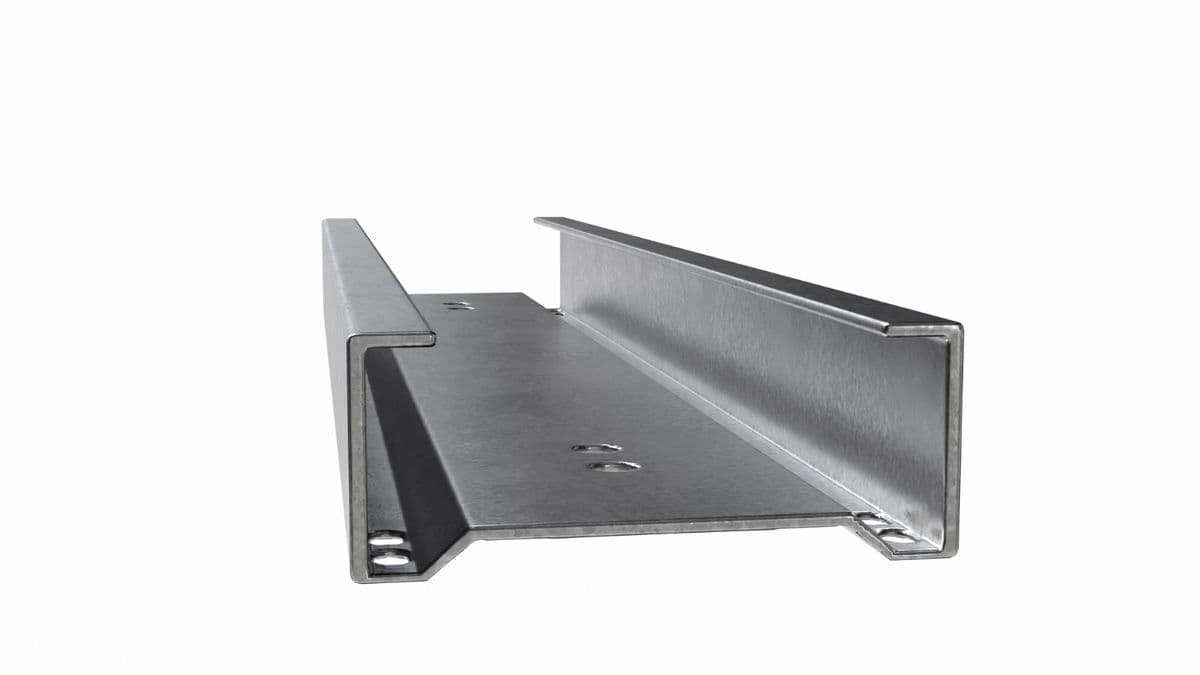
Sigma Pile
Stepped, rib-stiffened web — more moment at the same gauge, and grip for deeper embedment in soft ground.
Learn More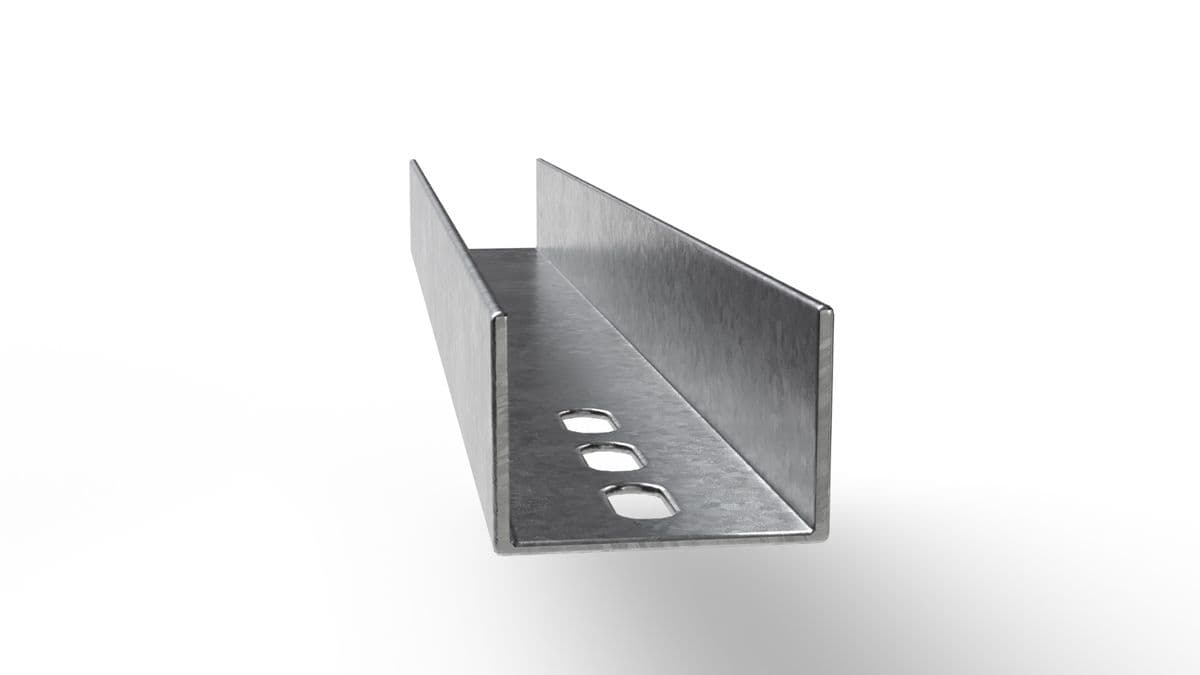
U-Pile
An open channel for lighter loads and compact frames — economical where a full C-section isn't needed.
Learn MorePurlins & Rails
C and Z purlins and omega rails that carry the modules — pre-punched, ZM-coated, to drawing.
Learn More